- Alex & Books Newsletter
- Posts
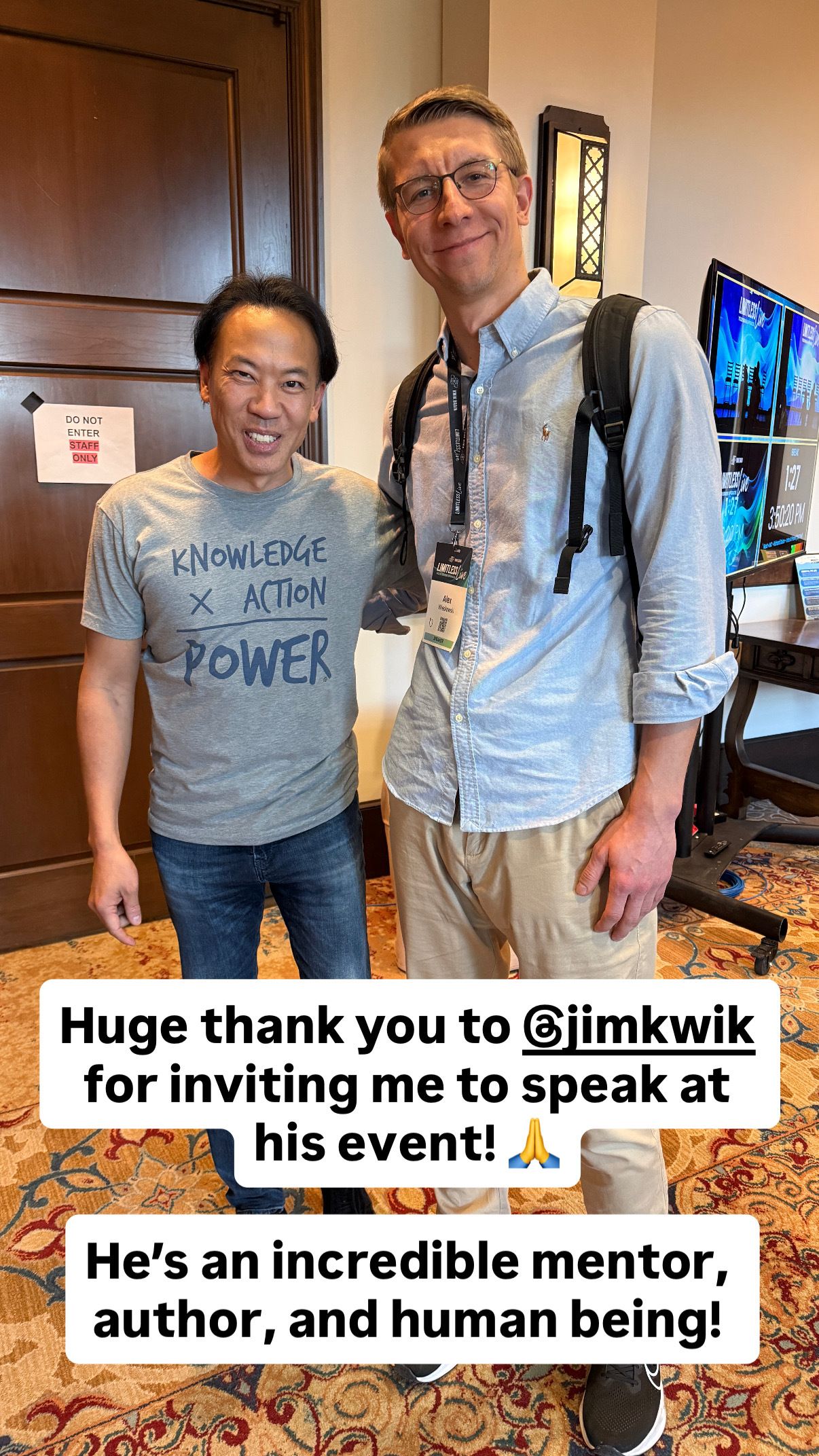
- 📚 How to Breakup With Your Phone, I Gave a Talk to 400+ People, and more.
📚 How to Breakup With Your Phone, I Gave a Talk to 400+ People, and more.
A&B #273
In partnership with

👋 Hey everyone,
Here are a few popular posts you may have missed:
This week’s newsletter was made possible by:
Your Entire Studio, Right on Your Laptop

Record, edit, and publish your best content without needing a crew, studio, or complicated setup.
With Riverside, you capture high-quality video and audio, edit it instantly with AI, and turn one recording into clips, posts, and podcasts ready to share. All so you can spend less time troubleshooting tech and more time creating the content your audience actually wants.
Imagine finishing your session by lunch and sharing finished clips before your afternoon coffee. Riverside puts the power of a full studio right on your laptop so you can create faster, sound better, and look professional anywhere.
📚 Books Summary:
This week's book is “How to Break Up With Your Phone” by Catherine Price.

If your phone is the first thing you reach for in the morning and the last thing you touch before bed, you need to read this book.
In it, health journalist Catherine Price shares shocking stats about the negative impact phones have on our lives and how to create a healthy relationship with this dangerous device.
Here are 3 lessons from the book:
📖
1) We’re All Addicted To Our Phones
Here are some scary stats around smartphone usage that will hopefully scare you enough to take action:
The average adult checks their phone about 144 times per DAY.
During waking hours, 83% of adults keep their phones near them almost all the time.
72% of adults keep their phones within arm’s reach while they sleep.
89% of adults check their phones within 10 minutes of waking up.
41% of adults report that they are online “almost constantly.”
57% of adults describe themselves as being “addicted” to their phones.
Phone usage has increased so much that certain injuries have been classified as “text neck,” “texting thumb,” and “cellphone elbow.”
Multiple studies have associated the heavy use of smartphones with negative effects on self-esteem, empathy, self-image, and an increase in sleep problems, anxiety, stress, and depression.
Using a smartphone is like eating a donut. It feels great in the moment, but we feel like crap afterward. And the big problem is just like how sugar is addictive, so are our smartphones. And we keep going back for more, over and over again.
We all need to change our phone habits before it has a serious impact on us.
📖
2) Your Phone Is Destroying Your Attention Span
If you feel like your attention span is that of a goldfish nowadays, you’re right.
Even though we’re on our phones for long stretches of time, we’re constantly scrolling, swiping, and switching between apps. And to make things worse, every message, story, or notification pulls our brains in a different direction.
In other words, we’re spending hours every day essentially training ourselves to be distractible. Tech expert Linda Stone has referred to this phenomenon as being in a “state of continuous partial attention.”
In 2004, attention researcher Gloria Mark found that the average length of time people stayed focused while working on a computer was around 2 minutes and 30 seconds. Today, the average amount of time people spend on any screen before switching is around 47 seconds.
But that’s not all. It takes around 25 minutes for your brain to refocus after it’s been distracted.
So if you’re in a state of flow while reading a great book or working on a creative project, and you go to answer a text or email, that quick message didn’t cost you 1 minute; it cost you 25 minutes.
Additionally, our phones may have tricked us into believing we’ve become better at multitasking, but that’s far from the truth.
Yes, we can do the dishes while listening to a podcast, but we can’t do two cognitively demanding tasks at once.
Instead, when we have two cognitively demanding tasks, such as writing a serious email while watching a movie, what we’re actually doing is task-switching.
However, each time we switch tasks, we pay a cognitive penalty because our brains need to change directions. It’s mentally and physically exhausting (blood pressure and heart rate both increase when we try to multitask). And multitasking increases feelings of anxiety, stress, and burnout.
We think we’re doing more–but we’re actually doing less.
📖
3) Start Setting Healthy Boundaries With Your Phone
Your phone is like a semi-toxic relationship with a family member.
You may not be able to cut them off completely from your life, but you can set up healthy boundaries to improve your relationship.
Here are a few quick tips to build a better relationship with your phone:
Keep your phone out of your bedroom: buy a regular alarm clock so you aren’t tempted to scroll your phone late into the night and don’t automatically open your phone first thing in the morning.
Redesign your home screen by moving all of your “trouble apps” (social media, news, etc) to the last page of your phone. You don’t want the bad apps to be the first thing you see every morning when you open your phone.
Set screen time limits on all of your “trouble apps.” That way, if they suck you in, screen time limits will remind you when your time is up.
To take an even more effective step, delete all of your “trouble apps” so that you can only use them on your laptop and not on your phone.
Turn off all notifications from your “trouble apps.” You don’t need to get a notification every time an old high school friend posts a new picture of their baby.
Pick one day a week (likely Saturday or Sunday) where you put your phone in a drawer and spend the entire day without your phone.
✅ Actionable Advice
1) If you don’t think you’re addicted to your phone, check your daily screen time.
2) Stop trying to multitask and focus on doing one task at a time.
If you’re doing an important task that requires serious thought, don’t do a quick phone or email check, it will disrupt your state of flow and take you 25 minutes to get back in it.
3) Buy or borrow a copy of ”How to Break Up With Your Phone.” It’s worth reading.
💎 Weekly Gem:
Here are 3 awesome (and free) newsletters worth checking out:
1) Dorie Clark: Dorie is the bestselling author of “The Long Game” and 4x Top 50 business thinker. Every week, she shares ideas that will help you think more deeply and challenge yourself to improve. Join 70,000+ readers here.
2) Jenny Wood: Jenny is the NYT bestselling author of “Wild Courage” and a former Google executive who created one of the largest career development programs in Google's history. In her newsletter, she shares strategies you can use to grow your career and life. Join 70,000+ readers here.
3) Nick Maguilli: Nick is the author of two amazing books, “Just Keep Buying” and “The Wealth Ladder.” He also has a fantastic newsletter called Of Dollars & Data that will help you understand the market and make better financial decisions. Join 40,000+ readers here.
Your opinion matters!
What did you think of this week's newsletter? |
Thank you for your support,
Alex W.
Reply